The Maintenance Concept:

The Maintenance Concept encompasses the areas of repair philosophies,maintenance support levels,manpower for maintenance,and the costs associated with maintenance. It serves the two purposes:

1.It establishes the basis for maintainability requirements in equipment/system design. For example, if the repair philosophy demands that external help will be available at the organizational level of maintenance the equipment design must incorporate some in-built tests so that the user can take care of the maintenance aspects as well.

2. It establishes the basis for the requirements for total maintenance support, which is important to complete the task. These requirements can be arrived at with the help of a proper maintenance analysis.Through proper analysis of the maintenance requirements and the anticipated frequencies of failures, the crew skill levels, the spare parts, the tools and the facilities required can be worked out in advance.

The maintenance concept must be developed at the inception of a program prior to the start of equipment design, in order to ensure that all the functions of design and support are integrated and geared towards meeting the overall maintenance concept .

PANGULONG DUTERTE NAGBIGAY NA NG GO SIGNAL SA ENERGY CHIEF PARA BUHAYING MULI ANG BATAAN NUCLEAR POWER PLANT!

President Rodrigo Duterte changed his mind  and has given his go signal to proceed with plans to reactivate the mothballed Bataan Nuclear Power Plant, after initially rejecting the use of nuclear energy in the Philippines under his watch.
Energy Secretary Alfonso Cusi said, however, that the President instructed him to pay special attention to the safety and security aspects of operating the 40-year-old power facility which was completed but never fueled and commissioned.
“He raised his concerns, and I gave him the assurance that we would not do it recklessly,” Cusi said.

“I reassured him that all of his concerns will be addressed. We are going to follow the strict measures of the International Energy Agency,” the energy chief added .

Cusi said, however, that electricity generation start at a lower level, then later scaled up to full power once a certain level of operating efficiency and expertise is achieved.
However, because most of the officials and personnel who were originally part of the 1970s-era BNPP program have either retired or passed away, the energy chief admitted that the government does not have the technical expertise to rehabilitate or operate the plant.
“Our human resources in that sector are gone, so we have to develop that, and those [Filipino nuclear experts] who have moved to other countries will be invited back,” he said.
“The deal to revive BNPP will either be a government-to-government effort or something that will be undertaken by a private corporation which will be chosen through a transparent bidding process,” Cusi added. 
It has been known that after the overthrow of President Ferdinand Marcos in 1986, President Corazon Aquino decided against operating the plant.

Source: Inquirer & pinasupdatesph.blogspot.com
Like and Share!
Disclaimer: Contributed articles does not reflect the view of http://NESBAS.HOME.BLOG/ . This website cannot guarantee the legitimacy of some of the information contributed to us. You may do additional research if you find some information doubtful. This site/blog shall not be responsible for any incorrect or inaccurate information, whether caused by website users or by any of the equipment or programming associated with or utilized in this website or by any technical or human error which may occur.


Preventive and Predictive Maintenance

Preventive/Predictive Maintenance
The guiding principle of PPM is the regular and systematic application of engineering knowledge and maintenance attention to equipment and facilities to ensure their proper functionality and to reduce their rate of deterioration. In addition to dedicated engineering, PPM encompasses regular examination, inspection, lubrication, testing and adjustments of equipment without prior knowledge of equipment failure. PPM also provides the framework for all planned maintenance activity, including the generation of planned work orders to correct potential problems identified by inspection. The result is a proactive (rather than a reactive) environment, optimizing equipment performance and life. Properly developed PPM programs are engineered efforts, which optimize the relationship between equipment ownership and operating profits by balancing cost of maintenance with cost of equipment failure, and associated production losses. Equipment ownership cost is a function of three factors: purchase price, equipment life and maintenance cost. Total maintenance cost is the sum of material and labor cost required to repair the item, the cost of preventive maintenance to avoid repairs, plus the cost of lost production while the unit is out of service for repairs. PPM includes actions which extend the life of equipment and avoid unnecessary failures by substituting selective programmed effort for “fix it when it fails” maintenance. Actions that extend the life of equipment include: lubrication, cleaning, adjusting and the replacement of minor components like drive belts, gaskets, filters, etc. Actions that avoid unnecessary failure include timely, consistent equipment inspection and the aggressive use of nondestructive testing techniques such as vibration analysis, infrared testing, oil analysis and other techniques. Predictive maintenance is the complement of preventive maintenance. Through the utilization of various nondestructive testing and measuring techniques, predictive maintenance determines equipment status before a breakdown occurs. With predictive devices currently available, it is incumbent upon maintenance organizations to include the process of predictive maintenance in their maintenance programs.
A total PPM program is absolutely essential to an efficient, reliable and safe production process. Benefits are direct and substantial, including: high product quality, long machine life, avoidance of work stoppage, high safety, high morale and fewer frustrations. There are five essential requirements:

  1. Top management leadership and absolute commitment.
  2. Compliance and discipline. PPM must be a normal part of schedule and capacity determination.
  3. Process operators should be involved and perform daily maintenance checks.
  4. The “true cost of poor maintenance,” which is several times initial estimates must be thoroughly understood by all.
  5. Good PPM practices must be instituted immediately to enable the facility to achieve an efficient production system that delivers high quality goods on time, every time. Although treated as separate elements, preventive/predictive maintenance, Reliability Engineering, equipment history and functional pride and quality assurance are inextricably supportive—each to the others. Success of the preventive/predictive maintenance program is dependent upon the existence of the other three elements. While planning and scheduling assure the effective utilization of resources to sustain an established proactive maintenance program, it is these four elements working in concert that define the proactive program.
    Logically, an effective maintenance program, supported by these four essential elements, begins with equipment history. Then, based upon this factual information foundation, Reliability Engineering begins the development and subsequent refinement of a preventive/predictive maintenance program. An Preventive and Predictive Maintenance effective scheduling function assures that PPM routines are punctually performed as they become due, as follows:
    A. The planning and scheduling program provides a structure into which PPM routines are woven. If PPM routines are continually shoved to one side, a proactive environment will never become reality.
    As scheduling contributes to the success of preventive maintenance so preventive maintenance contributes to the success of scheduling. The greatest obstacle to effective scheduling is the spasmodic occurrence of emergency breakdown repairs. Through scheduled inspections of equipment and repairs during scheduled downtime, emergency breakdowns can be nearly eliminated; thus the cause of interruptions to the planned schedule is removed or reduced to a minimum.
    B. Program consistency and punctuality is a must. PPM must be viewed and conducted as an ongoing and controlled experiment to be continually nurtured and refined. It requires dedicated,uniquely talented effort (the maintenance engineer).

Program results will carry to the bottom-line in the form of:

  1. Reductions in the total cost of maintenance
  2. Fewer urgent and emergency interruptions to operations due to equipment breakdowns
  3. Level workloads and a stabilized work force
  4. Reductions in the total labor needed to maintain facilities in the required condition
  5. Controlled reductions in the inventory of materials and spare parts
  6. Increases in the volume of work that can be planned and scheduled repetitively, and a decrease in high priority, randomly occurring and unscheduled work
  7. Reduced unnecessary damage to equipment

Preventive/Predictive Maintenance

Indicators of Ineffective PPM

  1. Low equipment utilization due to unscheduled stoppages
  2. High wait or idle time for machine operators during outages
  3. High scrap and rejects indicative of quality problems
  4. Higher than normal repair costs due to neglect of proper lubrication, inspections or service.
  5. Decrease in the expected life of capital investments due to inadequate maintenance

Effective PPM Requires:

  1. Top management understanding of the true cost of poor maintenance, which is several times initial estimate
  2. Sustained management leadership and absolute commitment
  3. Knowledge of equipment/process conditions required to yield quality, output, safety, and compliance standards
    A. One cannot determine what problems exist until knowing what conditions are proper
  4. PPM and other programmed maintenance must be a normal part of schedule and capacity determination. Management must insure that PPM is never delayed.
    A. PPM must be conducted as a Controlled Experiment
  1. Plan
  2. Do
  3. Evaluate
  4. Refine
    B. Weekly adherence to a balanced PPM schedule
  5. Dedicated staffing is preferable
  6. Operator should participate in daily machine checks
  7. Efficient PPM routes
  8. Effective PM checklists defining program required limits of equipment condition
  9. Adequate Equipment Records and Equipment Histories
  10. Three phases
  11. A. Detection—the key element
  12. B. Analysis—defines the specific problem from which the symptom originates
  13. C. Correction—the return of the PPM investment

OUTGOING SPEAKER GMA PUSHES SENATE TO WORK ON 11 BILLS STILL PENDING IN THE SENATE! Source Press and Public Affairs Bureau

Remaining priority bills of President Duterte, awaiting action from the Senate

In the last three weeks of the 17th Congress, former President and now Speaker Gloria Macapagal Arroyo is making last ditch effort to push for the legislative agenda of President Duterte.

In a letter sent to Senate President Tito Sotto, Speaker Arroyo said the House of Representatives is looking forward to the action of the Senate on 11 priority bills which are still pending in the Upper Chamber.

She pointed out that in the last three weeks of session before the end of the 17th Congress and before she steps down, she is looking forward to the action to be taken by the Senate on the 11 remaining priority bills of President’s Duterte which had been passed by the House on second and third reading but are pending at the Senate.

“As for the eleven (11) pending bills in the President’s priority legislative agenda, we await the action of the Senate and stand ready to adopt the Senate version in the interest of speedy legislation,” she said.

She also pointed out that the House re-introduced a bill on the creation of the Coconut Industry Trust Fund which she hopes would “conform more to the policy direction of the Executive and thus constitutes our main priority for our last three weeks’ work in the House of Representatives.”

The said bill was vetoed by the President.

Speaker Arroyo also said she considers it an honor to have worked with the Senate to carry out the legislative agenda of President Duterte.

“It has been an honor doing legislative work with you,” she concluded.

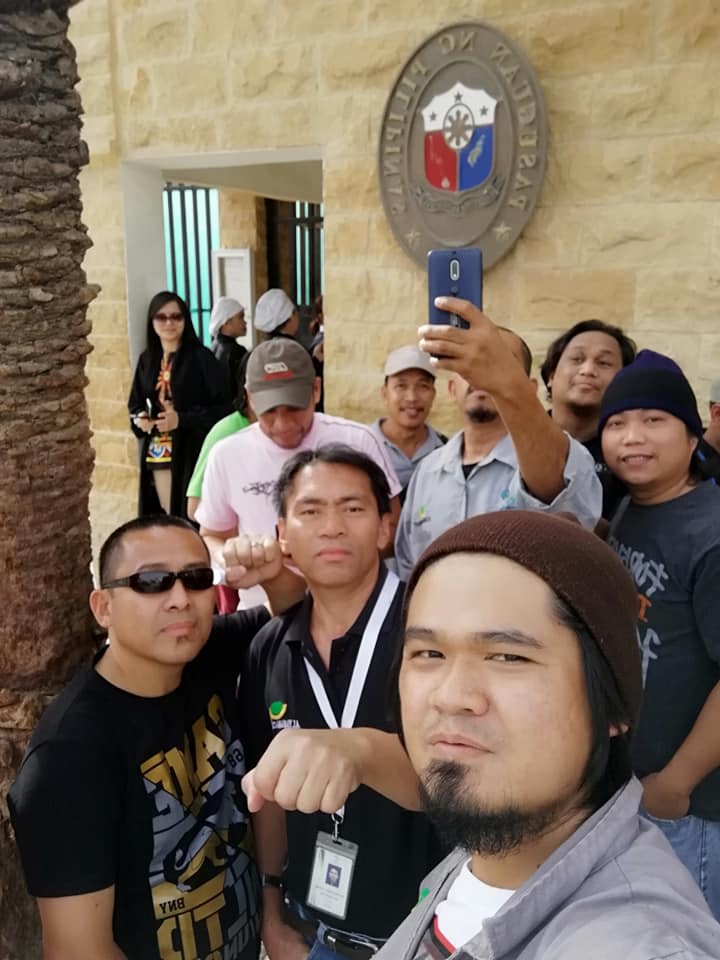
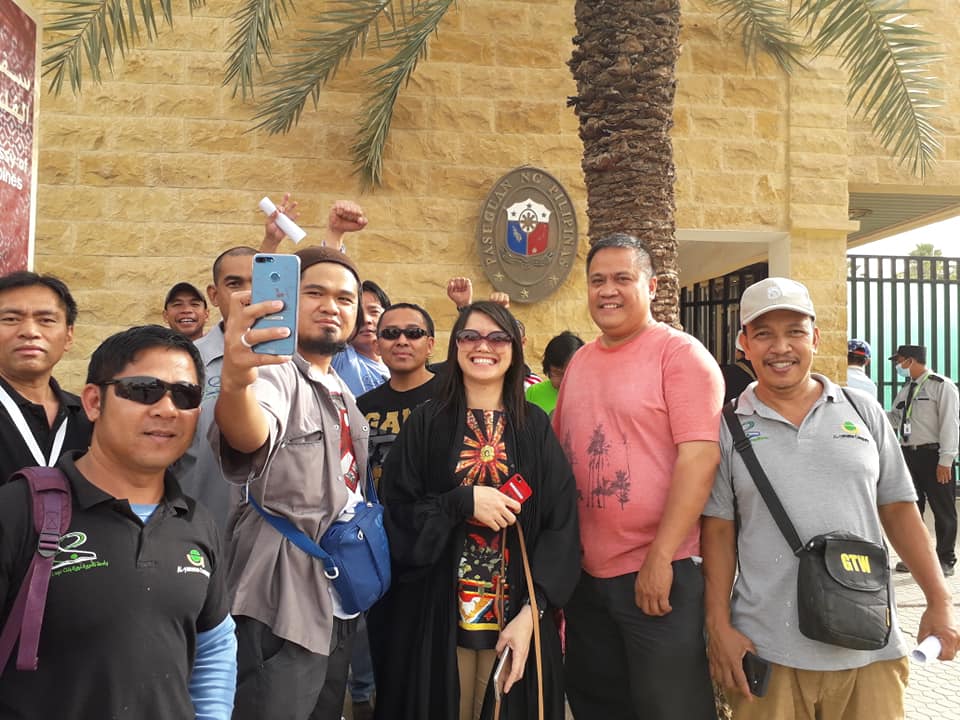
Filipinos vote in PE Riyadh on 24th day of overseas voting


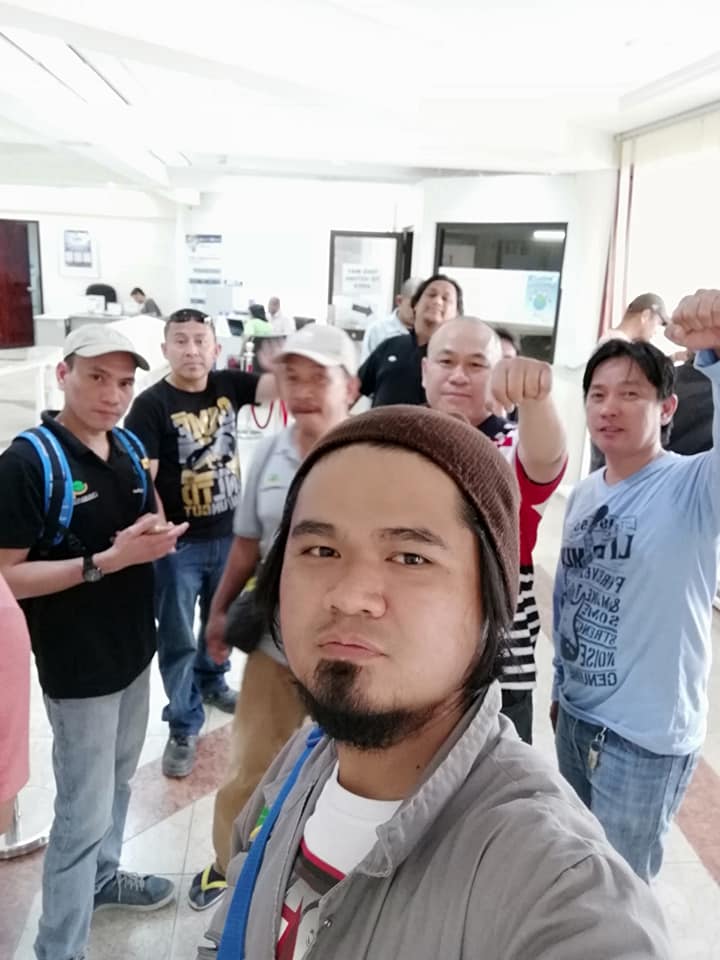
Overseas Filipino workers in Riyadh started coming in groups, apparently from work asking permission to their company in order to vote.

They cast their votes in the Philippines’ 2019 elections.

Approximately 25 Filipinos trooped to the Philippine Embassy in Riyadh to cast their votes on the 24th day of the overseas midterm elections.

They cast their votes at stake in this electoral exercise are 12 Senate seats and one party-list member in the lower house of Philippine Congress

This year’s electoral exercise appears off to a good start. The embassy in Riyadh was likewise busy with voters.