Good Boss

  • Better to have a GOOD BOSS in a bad company, rather than a BAD BOSS in a good company!  Agree?

A bad boss can make your job bad even in a very good company – they will micromanage you, blame you, and make your life miserable.

A good boss will stand up for you, will trust you, will listen to you, and will make yours a good job even in a weak company.

Work Value

  • Work for someone who values your talents, hard-work and loyalty. Life is too short for anything else!

Go where you are celebrated, not just tolerated.

If they do not see the real value of you, it’s time for a brand new start.

If you dread Mondays, and your favorite F-word is Friday, then perhaps it’s time to answer the call of a recruiter.

Leaders that do not see values of talent, hard-work, and loyalty in their employees do not last, anyway.

A job of a leader is to recognize the value of their people, and encourage them accordingly with PRIDE:

  • Promote – P
  • Reward – R
  • Involve – I
  • Defend – D
  • Empower – E

Perseverance

  • Success is a slow steady progress; it takes 20 years to become an overnight success.

“Many of life’s failures are people who did not realize how close they were to success when they gave up” Henry Ford

“The main difference between success and failure is pure perseverance.” Steve Jobs

“Perseverance is failing 19 times and succeeding the 20th.” Julie Andrews

Which is why you will be successful ! Because you persevere, AND you appreciate others who do the same.

You may think your progress is slow, but look back and see how far you traveled.

I am so inspired by people who get up, show up, give it all he got and never give up.

Work hard. It is better to be tired than disappointed.

PETROL ENGINE AND DIESEL ENGINE


  • The main difference between petrol and a diesel engine is the way they work and Use their fuels. What happens in a petrol engine is that at first the fuel is mixed with air, then piston compresses it and after compression it is ignited by spark plugs.

There is also a lot of difference between petrol and diesel engine and these are as follows:

  • The petrol engine works on Otto cycle whereas diesel engine works on diesel cycle.
  • In petrol engine the air and petrol are mixed in carburetor and it enters into the cylinder.
  • In diesel engine the fuel is first fed into the cylinder by a fuel injector and then gets mixed with air inside the cylinder.
  • In petrol engine first the compression of air and petrol is done and then it is ignited by an electric spark.
  • In diesel engine only the charge of air is compressed and ignition is done by the heat of compressed air.
  • The compression ratio in petrol engine is low as compared with the diesel engine.
  • The power developed in petrol engine is low due to lower compression ratio.
  • In diesel engine the power developed is more due to higher compression ratio.
  • Petrol engine is fitted with spark plug whereas diesel engine is fitted with a fuel injector.
  • In petrol engine the fuel that burns has high volatility. In diesel engine the fuel of less volatility is burnt.
  • Petrol engines are used in light weight vehicles like car, motorcycles, scooters etc.
  • Diesel engines are used in heavy vehicles like buses, trucks, locomotives etc.
  • Fuel consumption in petrol engine is higher than the diesel engine.
  • Petrol engine is lighter whereas diesel engine is heavier.
  • Frequent overhauling is required in petrol engine but overhauling of diesel engine is done after a long time.
  • There is lesser starting problem in petrol engine as compared with diesel engine.
  • Petrol engine has lowered initial and maintenance cost but the initial and maintenance cost of diesel engine is high.

  • Gasoline (American English) or petrol (British English) is a transparent petroleum-derived liquid that is used primarily as a fuel in spark-ignited internal combustion engines.

  • Diesel fuel itself acts as a lubricant for the fuel pump and delivery system as well as the valve train. Running thin, low viscosity gasoline through a diesel fuel system would starve it for lubrication and cause those sensitive components to rub together, eventually destroying them.

  • The diesel engine (also known as a compression-ignition or CI engine), named after Rudolf Diesel, is an internal combustion engine in which ignition of the fuel, which is injected into the combustion chamber, is caused by the elevated temperature of the air in the cylinder due to the mechanical compression (adiabatic compression).

  • GASOLINE ENGINE  has an internal-combustion engine that burns gasoline; most automobiles are driven by gasoline engines.
  • Chemical analysis and production. The bulk of a typical gasoline consists of a homogeneous mixture of small, relatively lightweight hydrocarbons with between 4 and 12 carbon atoms per molecule (commonly referred to as C4–C12). It is a mixture of paraffins ( alkanes ), olefins ( alkenes) and cycloalkanes (naphthene).

  • Fuel gas is any one of a number of fuels that under ordinary conditions are gaseous. Many fuel gases are composed of hydrocarbons (such as methane or propane), hydrogen, carbon monoxide, or mixtures thereof.

Difference Between Petrol and Diesel Engine in Tabular Form

S.No Petrol Engine Diesel Engine
       1. The petrol engine works on Otto cycle i.e. on constant volume. The diesel engine works on diesel cycle i.e. on constant pressure.
         2. The air and petrol are mixed in the carburetor before they enter into the cylinder. The fuel is fed into the cylinder by a fuel injector and is mixed with air inside the cylinder.
          3. The petrol engine compresses a mixture of air and petrol which is ignited by an electric spark. The diesel engine compresses only a charge of air and ignition is done by the heat of compression.
          4. Compression ratio is low. Compression ratio is higher in diesel engine.
          5. Less power is produced due to lower compression ratio. Due to higher compression ratio more power is produced.
          6. Petrol engine is fitted with a spark plug It is fitted with a fuel injector.
          7. Burns fuel that has high volatility. Burns fuel that has low volatility.
      8. They are used in light vehicles which requires less power. Eg: car, jeep, motorcycle, scooters etc. They are used in heavy vehicles which require high power. Eg: bushes, trucks, locomotive etc.
         9. Fuel consumption in petrol engine is high. Fuel consumption in diesel engine is less.
        10. Lighter Heavier
       11. Petrol engine requires frequent overhauling. Overhauling of diesel engine is done after a long time.
      12. Lesser starting problem. Greater starting problem.
      13. Lower initial cost. Higher initial cost.
       14. Lower maintenance cost. Higher maintenance cost.

Pump vs Turbine


  • Pump and turbine are two devices that are widely used in many industries. The turbine is a device that is capable of gathering energy and converting it to work. The pump is a device that is used to move fluids. Both of these devices are very important in fields such as electrical engineering, mechanical engineering, civil engineering, constructions, power generation, automobile engineering and numerous other fields.
Centrifugal Pump


  • A pump is a device that is used to move fluids. Pumps use mechanical energy to transfer these fluids. The most common example for the pump is the air compressor. It takes air from outside and transfer it to the inside overcoming the pressure of the gas inside. The pump is the device which does the work on the fluid in order to get it to a higher energy or entropy state.

  • Most of the mechanical pumps are based on a rotary motion. There are pumps that operate on a linear motion too. Most pumps are driven by either electric motors or fuel engines. A pump does not convert energy to different forms; it rather directs the energy on a desired way. Some energy is always lost as sound, vibrations, and heat; therefore, a pump is not 100% efficient. The three main types of pumps are known as direct lift pumps, displacement pumps, and gravity pumps.

Turbine

A turbine is a device that is capable of absorbing energy from a given fluid stream and converting it to useful work. A turbine consists of a shaft or an axel which can be rotated around its own central cylindrical axis and blades attached to it. The blades of a turbine have the shape of the blades of a fan. An incoming fluid stream causes the axel to turn. 


  • This is the reverse process of a fan. This motion gives a uniform circular motion at the tip of the turbine. This end can be connected to a dynamo to produce energy. It can be connected to a pump to drive water from a deep well to a tank. Windmills and waterwheels are some of the oldest turbines. A turbine loses energy in the form of friction, sound, heat, and vibrations. This means the turbine is not a 100% efficient machine.

Valves Types

The functionality of the valve

• Control: pressure / flow rate regulation.

• Closure at over-speed flow. (i.e. immediate closure if downstream pipeline is broken by accident).

• Overpressure protection.

• Back flow prevention (check valve).

• On/Off service.

Classification

There are two major methods used to classify valves. These include method of control and valve function. Most valves fall into one or more of the classifications listed below. It is important to understand how the valve operates, as well as how it is best used, to reduce the need for valve maintenance and extra wear on the valve parts.


  • Ball Valves
    Butterfly Valves
    Globe Valves
    Gate Valves
    Diaphragm Valves

  • Ball Valves

  • Ball valves offer very good shut-off capabilities. A simple quarter-turn (90°) completely opens or closes the valve. This characteristic minimizes valve operation time and decreases the likelihood of leakage due to wear from the gland seal.

Butterfly Valves


  • In butterfly valves, the flow is regulated through a disc-type element held in place in the center of the valve by a rod. Similar to ball valves, valve operation time is short because the valving element is simply rotated a quarter turn (90°) to open or close the passageway.

Globe Valves

The globe valve is suitable for use on a wide variety of applications, from flow rate control to open/close operation.In this type of valve, flow rate control is determined not by the size of the opening in the valve seat, but rather by the lift of the valve plug (the distance the valve plug is from the valve seat). 
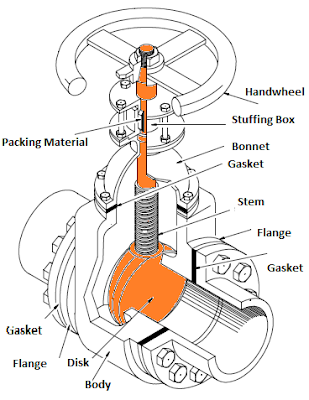
Gate Valves


  • The construction of a gate valve is similar to that of a floodgate: flow is controlled by raising or lowering the valving element, which is generally available in three different types: solid (plain), flexible, and split. The latter two types help prevent the valving element and body from being deformed due to various operating conditions.

Diaphragm Valves


  • Diaphragm valves use a ‘pinching’ method to stop the valve flow using a flexible diaphragm. They are available in two types: weir and straight-way. The most commonly seen of the two is the weir-type. This is because the straight-way type requires additional stretching of the diaphragm, which can shorten the diaphragm’s life-span.